
The best place to start with writing job applications is reviewing the job advertisement in full. It sounds obvious but too many people do not read the full advertisement and miss key instructions. As you are reading, keep your eyes open for the points that give you a solid insight to this role. A good advertisement will have a solid statement about what this position is all about.
For example, this WHS Inspector position advertised by the Queensland Government:
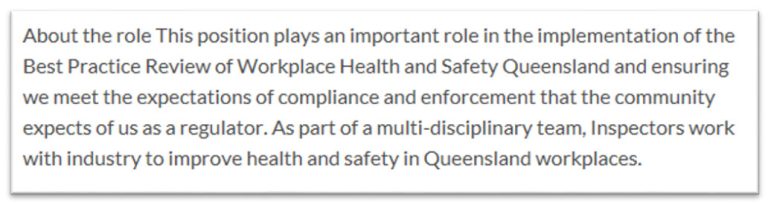
Always begin by breaking this down into components to ensure you have used the employer’s language to reflect these attributes in your application, your resume and even your Linked In profile. So, if we looked at the example of the WHS Inspector above, you would need to demonstrate:
- Implementing best practice in Work Health and Safety (WHS) – show them you are experienced in WHS at a best practice level. Choose examples of positions that you have held in your career that covered this and highlight these on your resume and LI profile.
- Compliance and enforcement – show the reader that you are compliance and enforcement focused, and have the WHS operational skills to do this role.
- Multi-disciplinary team – true team players are always sought after so include this language in your application.
- Improve health and safety practices in the workplace – find a way to give them data that shows you have the WHS wins to align with the organisation’s objectives.
Suggestion:
- Use the key phrases in your application documents. It makes it easier for the reader to tick off that you meet the criteria and where automated systems are reading your application, key phrases will assist your application to get in front of a pair of human eyes.
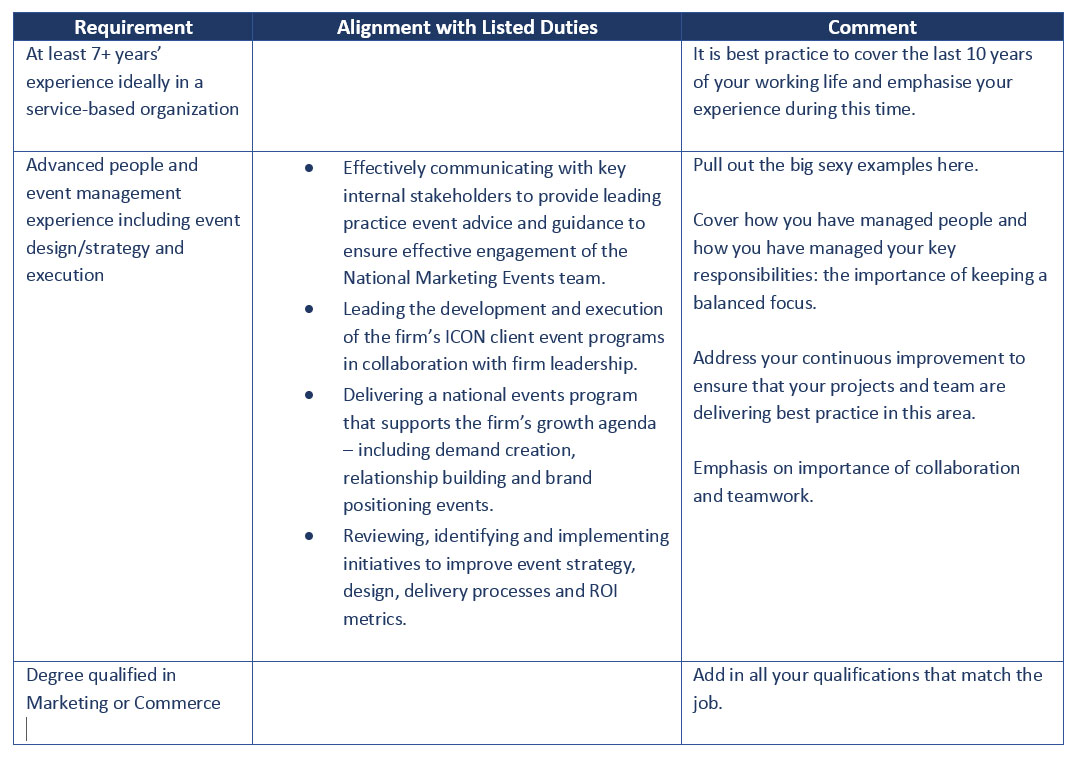
Advertisements often include a list of the mandated requirements (for example, how many years of service in the industry, licences or qualifications) and key responsibilities for the role. Before writing job applications for a new role, we recommend breaking these down into a table so you can see them clearly You can even offset the requirements and match against the listed duties. For example, a job advertised with KPMG had both key requirements and duties listed so we matched them up to make it easier to tackle in writing a job application. We add a column to add our thoughts as we were pulling apart the requirements and duties. A quick excerpt from our table for this position looked like this:
Suggestion:
- Use the attached table now to jot down your examples from each job and select the best for your application. Taking some time upfront will make it much easier to select your best examples. Think about what you did, how you did it, why you did it and how well you did it.
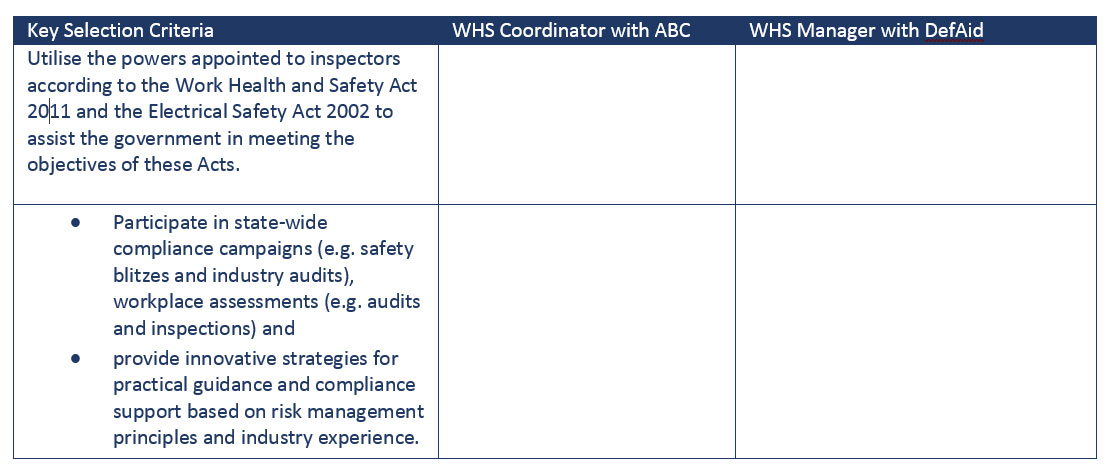
Government jobs always come with key selection criteria. When I was a young public servant, I had a mentor who spent time with me teaching me how to write responses to key selection criteria. Once she had taught me her secret sauce for Government jobs, I always landed every job I applied for and so did my friends who I taught too. This is what she told me: when writing job applications – responding to key selection criteria is not the time to be modest. This is your one shot at shining in the pack and that means giving your very best examples in your application. She recommended sitting down with a big piece of paper and drawing up a table on it. Down the left hand side, list every key selection criteria in the advertisement.
If a selection criteria has multiple parts, you can even break it down a little, like this:
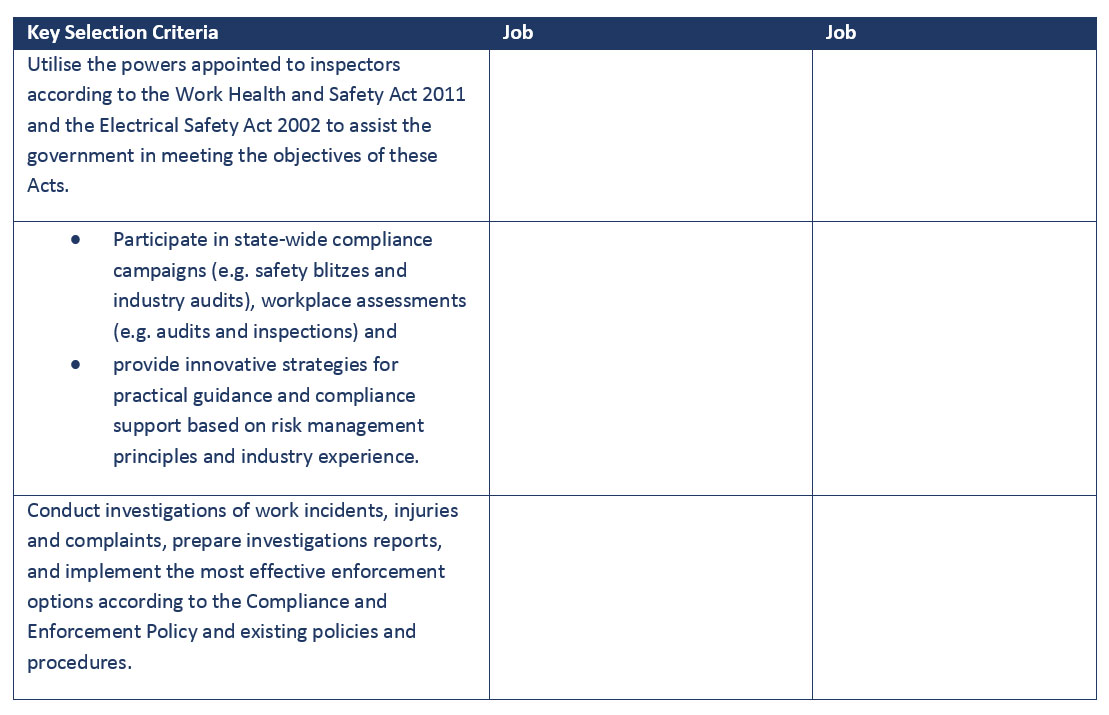
Then along the top line of the table, list every job you have held in this field over the last 10 years. With all of your positions listed, go along and jot down examples of projects (or investigations in this case) that you did that meet this selection criteria. Once you have filled this out, you now have a guide to choose your best examples from in writing your response to the key selection criteria. I often found it helpful to talk through your examples with a good friend, colleague or your partner because sometimes you can have done so much work that you overlook some of your best examples. Other people who know you well often remember the stand out achievements in your life and they can remind you of great examples. If you can’t think of a direct example for a key responsibility, think about any transferable
skills and examples you may have. For example, you may not have worked for a government agency before in compliance but you may have worked for a private company with a key focus on compliance. These are transferable skills and you should highlight them.