To negotiate a pay rise, research the market rate for your role, time your request well, and walk in with clear evidence of your value, including any new qualifications that prove your skills meet an industry standard. Below is a step-by-step approach and a word-for-word script you can adapt, written for the moment you have just had your experience formally recognised through Recognition of Prior Learning (RPL).
Gaining formal recognition of your existing skills, experience and knowledge through Recognition of Prior Learning (RPL) is an important milestone in your career.
Your expertise has been validated, strengthening your professional credibility and marketability.
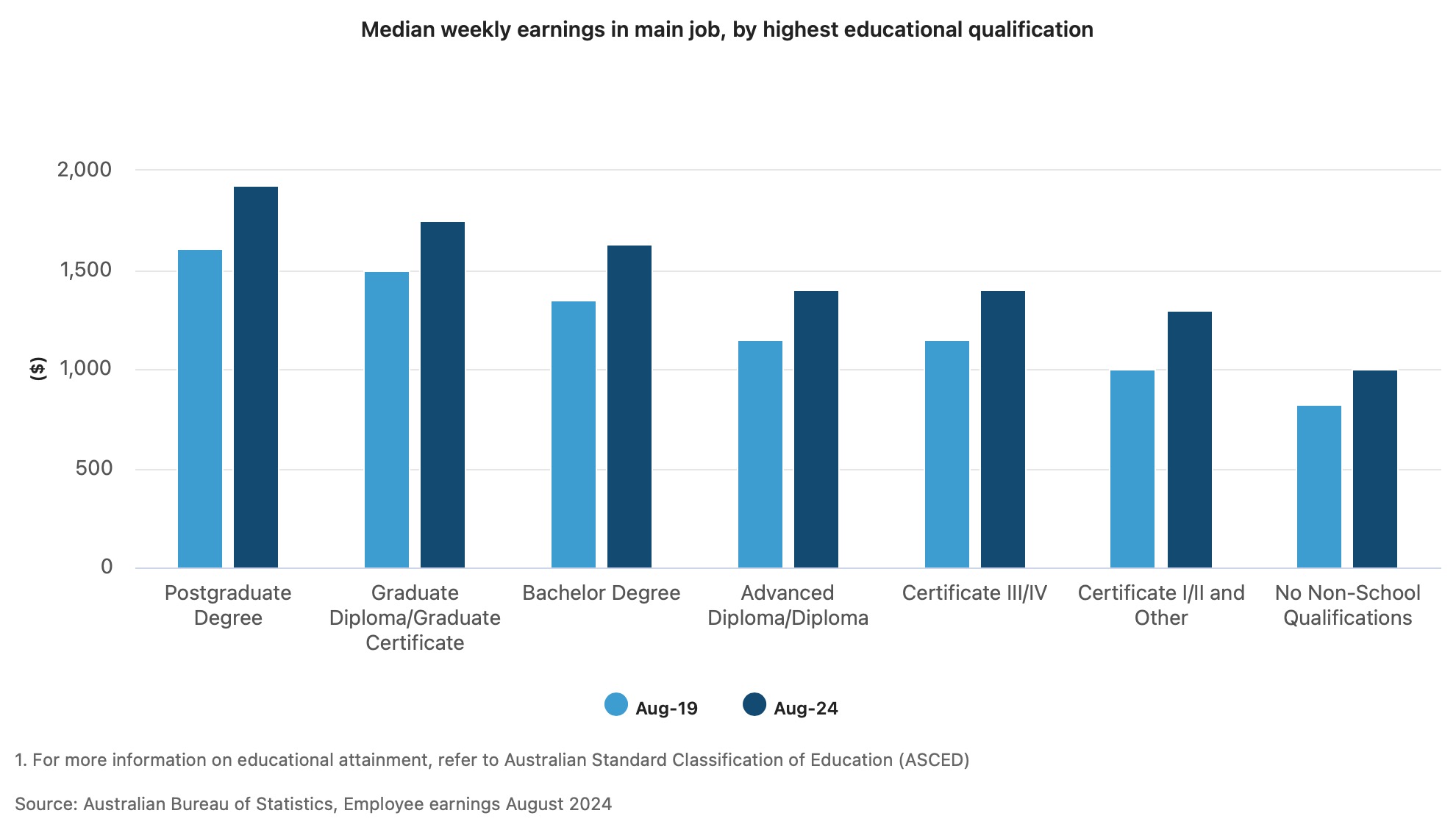
In Australia, there is a clear correlation between educational attainment and income levels. Australian Bureau of Statistics (ABS) data for August 2025 shows that median weekly earnings increase with higher qualifications.
Why your new qualification strengthens your case
A nationally recognised qualification is independent proof that your skills meet a defined industry standard, which is exactly the kind of evidence a pay-rise conversation needs. It also reflects a real earnings gap.
The same ABS data for August 2025 shows median weekly earnings climbing at every step up in qualification: from $1,000 a week for someone with no post-school qualification, to $1,400 with a Certificate III or IV and $1,462 with a Diploma or Advanced Diploma, rising to $1,700 for a bachelor degree. Having your experience recognised as a formal qualification puts you on a higher rung of that ladder, and gives you a concrete benchmark to point to.
How to negotiate a pay rise: a step-by-step approach
Before you book the meeting, do the groundwork. A confident, well-evidenced request is far more persuasive than the conversation alone.
1. Know what you are worth.
Research the going rate for your role, industry and location so your request is anchored to the market, not a guess. Aim to know both a fair figure and a realistic range.
2. Get the timing right.
Timing matters as much as the ask. The strongest moments are just after a clear win or a strong quarter, or at a scheduled performance review. Check how your employer normally handles pay reviews and work with that cycle rather than against it.
3. Build your evidence.
Keep a record of your achievements and tie them to measurable outcomes wherever you can, such as increased efficiency, revenue growth, cost savings, improved client satisfaction or projects delivered on time and on budget.
4. Lead with your new qualification.
Your recognised qualification is the freshest piece of evidence you have. Use it to show your skills have been formally validated against an industry standard since your last review.
5. Decide how much to ask for.
Have a figure and a range in mind before you walk in. Anchoring slightly above your target leaves room to negotiate towards a number you are happy with.
6. Have the conversation.
Book a dedicated meeting so you have your manager’s full attention, stay calm and professional, make your case, and then give them space to respond. The script below gives you the words for each step.
A word-for-word script for negotiating a pay rise
In some industries additional qualifications will automatically result in higher salaries, but for most of us, it comes down to our ability to negotiate on our behalf. And it’s not always easy to find the right words.
This script will help you confidently present your case for a salary increase by demonstrating how your newly recognised qualifications enhance your value to the company.

[Opening]: Thank you for taking the time to meet with me today. I really appreciate the opportunity to discuss my role and contributions to the company.
[Statement of Purpose]: Over the past [time period], I have been committed to enhancing my skills and expertise to bring even more value to my role. As part of this commitment, I recently achieved [qualification name]. This formal recognition highlights my ability to contribute to the team and our overall goals.
[Highlight Achievements and Value]: Since my last salary review, I have applied the skills recognised by this qualification to [specific examples of how your work has improved].
This has resulted in [mention any measurable outcomes, such as increased efficiency, revenue growth, improved client satisfaction, or successful project completion].
Additionally, I have taken on [any new responsibilities, leadership roles, or mentorship], which demonstrates my commitment to both my professional growth and the company’s success.
[Make the Ask]: Given my enhanced skill set, increased contributions, and the value I bring to the team, I would like to discuss the possibility of a salary adjustment that reflects my professional development. Based on industry benchmarks and my expanded role, I believe a salary increase to [desired salary or percentage increase] would be appropriate.
Note: Here are some resources for researching relevant industry benchmarks, so that you can come prepared to the conversation:
[Leave Space & Hold the Faith]: There’s a saying in sales—“whoever speaks first loses”. In many ways this is a sale. It is you selling you and the skills you bring to the team. At this point you might feel compelled to make concessions.
What you actually need to do now is keep quiet and allow your employer to respond. They will most likely need time to consider your request.
[Close Positively]: I appreciate your time and consideration, and I’m eager to continue adding value to the company. I’d love to hear your thoughts on this and explore a way forward that works for both of us.
What if the answer is no?
If you get a no to your request, you could respond with:
[Address Potential Concerns]: I understand that salary decisions involve various factors, and I am open to discussing how we can align my compensation with my contributions. If an immediate adjustment isn’t possible, I’d love to explore other options such as additional benefits, professional development opportunities (including future RPL), or a structured plan for a future salary review.
Good luck!
Find out what you’re eligible for
If you’d like to explore your eligibility for qualifications that recognise the expertise you bring to your current role, you can apply for one of our free RPL appraisals or call us on 1300 793 002.
Negotiating a pay rise: common questions
A common starting point is 5 to 10 per cent above your current salary, or higher if your role has grown significantly. Rather than naming a single figure, propose a range anchored slightly above the market rate for your role, which signals flexibility and leaves room to negotiate.
Timing is critical. The strongest moments are just after a clear achievement or a strong quarter for the business, or during a scheduled performance review. Check how your employer normally handles pay reviews, because asking outside that cycle can reduce your chances even with a strong case.
It often supports a higher salary. ABS data for August 2025 shows median weekly earnings rise with each step up in qualification. A nationally recognised qualification is independent proof your skills meet an industry standard, which strengthens the case you put to your employer. In some industries it leads to an automatic increase; in most, it gives you firm evidence to negotiate with.
Book a dedicated meeting, open by acknowledging your role, then explain that you have recently gained a formal qualification and applied those skills to measurable results since your last review. Make a clear, specific ask based on industry benchmarks, then give your employer space to respond. The word-for-word script above walks through each step.
Stay positive and keep the conversation open. Acknowledge that pay decisions involve many factors and ask what would need to change for a future increase. If an immediate rise is not possible, explore alternatives such as additional benefits, professional development (including further RPL qualifications), or a structured plan for a salary review at a set date.
If your skills come from years on the job rather than a classroom, Recognition of Prior Learning (RPL) can turn that experience into a nationally recognised qualification with no exams or coursework. Use the free qualification finder or apply for a free appraisal to see what you are eligible for.