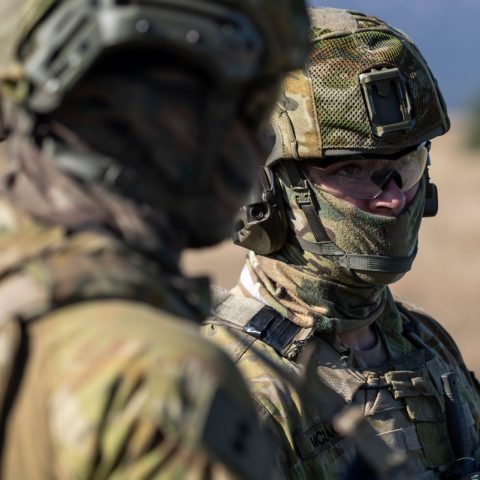
The course has been significantly redeveloped to ensure that infantry platoon commanders are battle-ready for warfare now and for the challenges of future warfighting. The cohort of lieutenants will complete demanding training that is focussed on live-fire platoon attacks, ambushes and defence, tactical navigation, and combined arms training in the Infantry Corps armoured and protected mobility vehicles.
The RAInf ROBC is conducted by the Combined Arms Training Centres School of Infantry at Singleton. NSW.
Across hundreds of Defence transitions, the same four qualifications keep opening doors. More than 5,000 permanent members leave the ADF each year, and the good news is that most go on to build strong civilian careers, with around 84% employed or engaged in purposeful activity after they transition.
The challenge is rarely capability. It’s translating years of service into something civilian employers and licensing bodies recognise on paper. That leap from defence to civilian qualifications is exactly what Recognition of Prior Learning handles: it assesses the skills you already have and turns them into a nationally recognised qualification, without sending you back to study what you already know.
These four ADF RPL qualifications come up again and again for one reason. They map neatly onto skills almost every ADF member already has, they’re nationally recognised, and they’re stackable qualifications, so you can build one on top of another as your civilian career grows. For most people leaving the service, they’re the best RPL qualifications for veterans to start with.
The four defence qualifications at a glance
Here’s how the top qualifications for defence RPL compare on cost, timeframe and the experience an assessor looks for:
| Qualification | Entry requirement (experience an assessor looks for) | Cost | Duration |
| Diploma of Work Health and Safety (BSB51319) | Experience managing safety and risk on the job | From ~$1,895 | A few months |
| Diploma of Leadership and Management (BSB50420) | Experience leading teams or managing people | From ~$1,895 | A few months |
| Diploma of Security Risk Management (CPP50619) | Experience assessing threats and managing security or risk | From ~$1,895 | A few months |
| Diploma of Government Investigations (PSP50416) | Experience investigating, gathering evidence, or applying procedures | From ~$1,895 | A few months |
RPL has no formal entry prerequisites; the entry requirement above is simply the kind of relevant experience an assessor draws on. All four Defence RPL qualifications sit at Diploma level, so the fee and timeframe are much the same.
A free appraisal confirms your exact quote, and you can see current fees on our RPL pricing page.
1. Diploma of Work Health and Safety (BSB51319)
The Diploma of Work Health and Safety recognises the safety leadership you’ve already lived. WHS roles are in strong, steady demand across construction, logistics, mining, and healthcare, and if you’ve led teams, managed risk or been responsible for safety on operations, this is a natural next step. It sits within our wider work health and safety pathway, and it’s often the qualification our Defence graduates say landed them their first major civilian role.
Common civilian roles include:
- Work Health and Safety Officer
- Work Health and Safety Manager
- Senior Safety Advisor
- Risk and Compliance Lead
2. Diploma of Leadership and Management (BSB50420)
If you’ve led others in uniform, you’ve already earned your stripes. But rank doesn’t always translate cleanly outside Defence, and that’s where the Diploma of Leadership and Management comes in. It turns your leadership experience into something civilian employers instantly understand and value, and for many veterans it’s the key to operational and middle-management roles. Explore the full leadership and management range to see where it can lead.
Common civilian roles include:
- Operations Manager
- Team Leader
- Project Manager
- Business Development Manager
3. Diploma of Security Risk Management (CPP50619)
If your service involved assessing threats, planning operations, and managing risk, the Diploma of Security Risk Management builds on exactly that. It’s the highest qualification in the sector and a strong fit for corporate security, emergency response, and infrastructure protection, areas where a Defence background is a genuine asset. It anchors our broader security risk management offering.
Common civilian roles include:
- Security Manager
- Security and Risk Consultant
- Emergency Response Lead
- Security Operations Manager
4. Diploma of Government Investigations (PSP50416)
There’s steady demand across councils, regulatory bodies and government departments for people who can run a thorough investigation. The Diploma of Government Investigations formalises that experience and backs you for compliance, auditing and investigation roles, where sound judgement and attention to detail are exactly what’s needed.
Common civilian roles include:
- Investigator
- Compliance Manager
- Regulatory Affairs Officer
Can you stack these qualifications?
Yes, and it’s one of the smartest ways to use RPL. These qualifications are stackable: a Diploma can build towards an Advanced Diploma, and the credit you earn can even shave time off a university degree later. Many Defence members start with the one that fits their next role and add to it as their civilian career takes shape.
For personnel with the right specialised experience, we’ve also been able to award qualifications in logistics, business administration, paramedical science and project management, among others. The four above are simply the ones that come up most.
How does Defence RPL work?
The mechanics are simple. Instead of studying, you pull together documentation of your service, and an assessor measures it against a nationally recognised qualification. Anything you can’t yet evidence is the only part left to complete.
Defence records make strong evidence, and most people already have what they need:
- Service and training records, including courses you’ve completed
- Posting orders and position descriptions that set out your responsibilities
- Performance reports and referees who know your work
- Concrete examples of what you planned, led, or signed off
You can begin before or after you discharge. Eligible serving and ex-serving members can also have up to two qualifications assessed free of charge in the 24 months after they leave, funded through ADF transition support, so it pays to check your eligibility early. Our defence members and veterans guide covers who qualifies.
Turn your Defence service into recognised qualifications with Churchill
You’ve already done the work. The last step is proving it in a form employers and licensing bodies recognise, and that’s where Churchill comes in. Our Defence RPL team turns your service into nationally recognised qualifications, usually in a matter of months.